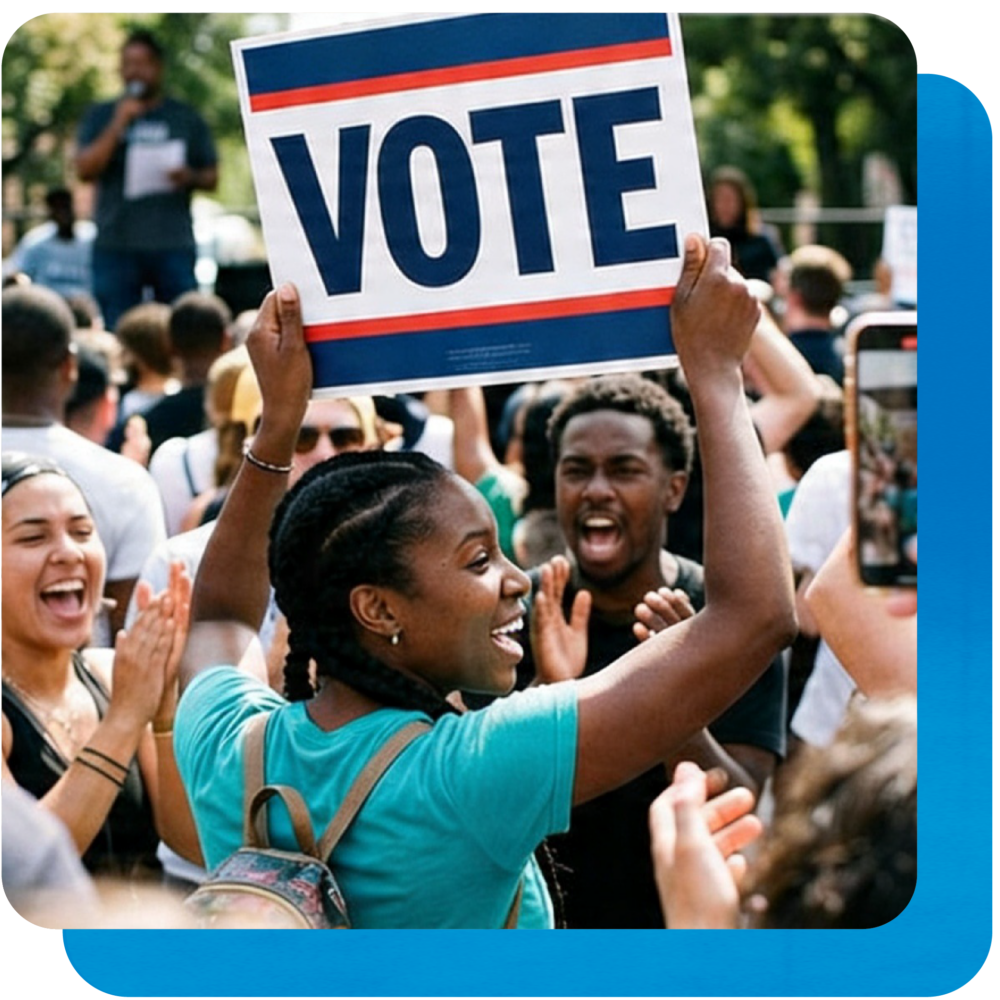
Local races often come down to a handful of votes. With digital organizing, it’s easier than ever to have real conversations with the voters most likely to support you, so you can focus your energy where it counts instead of spreading yourself thin ahead of Election Day.
If you’re a first-time candidate wondering when and how to start organizing, this guide is for you. The best time to start this 30-day plan is earlier than you think. The best time to start is six to nine months before Election Day. But with only a few months left, the next best time to start is now. The earlier you build the foundation, the more runway you have to arrive at Election Day with a real operation behind you.
Here’s how to build a real digital operation in your first 30 days.
Days 1-10: Lay the foundation
The first two weeks are about setting up the systems everything else will run on: knowing who you need to reach, building the list of people who can help you reach them, and getting those people ready to go.
Find voters in your district
Your voter universe is the group of people your campaign needs to move to win. In a local race, that universe is smaller than you think. This is actually an advantage. You’re typically looking for three groups:
- Your base voters who reliably turn out and need to be energized and cultivated
- Low-propensity supporters who are registered but don’t consistently show up in local elections
- Persuadable voters who have participated in past cycles but haven’t committed to a side
Understanding which bucket each voter falls into is what makes every volunteer hour count. The voter file is where you start. Your county party or local political party committee can help you access voter files. Without it, you’re guessing. With it, every volunteer hour goes further.
Build a campaign volunteer list
Before you work the voter file cold, build your warm list. This should include former colleagues, neighbors, and community members you’ve served alongside. In a race where your name recognition may be starting at zero, a text from a neighbor is worth more than anything your campaign sends directly. A simple sign-up form on your website makes it easy to capture names, emails, and phone numbers as you meet people at events. The list you build in these first ten days is the seed of everything that follows.
Recruit volunteers for a local campaign
Build a volunteer sign-up form before you need it. Keep it short: name, phone, zip, availability, and two or three clear role options. Then follow up within 24 hours of every sign-up, every time. Fast, personal follow-up is what turns a name on a form into a volunteer who actually shows up.
Onboard campaign volunteers
At this stage you need three types of volunteers: people who can make calls or send texts, people who can knock on doors, and people who can recruit others. Tell each volunteer what they’ll be doing and what a successful session looks like before they ever open a script. A volunteer who sends fifty texts and feels good about it will be much more likely to do it again next week.
Days 1-10 checklist
Your universe
- [ ] Obtain voter files
- [ ] Identify your target universe
- [ ] Confirm district boundaries and total registered voter count
Your list
- [ ] Build a first-pass warm list: colleagues, neighbors, community members who know you
- [ ] Set up a sign-up form on your website to capture names, emails, and phone numbers
- [ ] Bring a sign-up method to every event, forum, and community gathering
Your volunteers
- [ ] Build a volunteer intake form with 2–3 clear role options
- [ ] Establish a follow-up protocol: respond to every sign-up within 24 hours
- [ ] Identify your first three volunteer roles: texters/callers, canvassers, recruiters
- [ ] Brief each volunteer on their role before their first session
Days 11-20: Activate your network
You have a list. You have a volunteer team taking shape. Now it’s time to start making contact with voters who don’t yet know your name. This is the phase where campaigns start to feel real.
Write a voter contact script
Voters in your district are thinking about specific things; a road under construction, a school budget fight, a contested rezoning. Your script should reflect that. Keep it short, ground it in something real, and give volunteers two or three ways to handle common responses. Prepared volunteers have better conversations. Better conversations move voters.
Run your first volunteer training session
Your first volunteer training session is going to feel challenging. Run it anyway. Treat it as a training first; walk volunteers through the script, let them practice with each other, and make sure everyone understands the goal. Are you introducing the candidate, identifying supporters, or confirming turnout intentions? Budget at least 45 minutes for training before going live. That time comes back to you many times over in volunteer retention and contact quality.
Use the right kind of texting outreach
Text messaging is one of the most powerful outreach tools available to local campaigns. But not all campaign texting works the same way, and knowing the difference will shape how you deploy it throughout the race.
Broadcast texting sends one message to your full supporter list, and it’s usually the right tool for fundraising asks, event announcements, and mobilizing people who are already with you. It’s a list you build over time: every supporter who opts in becomes someone you can reach instantly when a moment requires it.
Peer-to-peer (P2P) texting is different: volunteers send messages individually to voters, and responses come back as real conversations. In a local race where your pitch depends on feeling like a neighbor rather than a campaign, P2P is how you make personal outreach scale. Use broadcast for your supporters, and use P2P for the broader voter universe.
Start canvassing (and bring the right tools with you)
Door-knocking is still one of the most effective things a local campaign can do. Start with the precincts where your target voters are most concentrated, and log every door: was someone home, what did they say, where do they fall on the support spectrum? Digital canvassing tools let volunteers log contacts in real time, and can be a significant upgrade over paper walk sheets that get lost before they’re ever entered.
Track every contact from day one
Your data is an asset that compounds. Every conversation by phone, text, or at the door should be tagged and recorded. Strong supporter. Soft yes. Undecided. Not home. Campaigns that build this discipline early know exactly who to call in the final 72 hours.
Days 11-20 checklist
Volunteer training
- [ ] Schedule your first phone bank or text bank session
- [ ] Prepare a script grounded in a specific local issue
- [ ] Build a short FAQ covering the 3 most common voter responses
- [ ] Run a practice round before going live
Voter outreach
- [ ] Begin peer-to-peer texting outreach into your voter universe
- [ ] Reserve broadcast texting for opted-in supporters only
- [ ] Identify your highest-priority canvassing precincts from the voter file
- [ ] Complete at least one canvassing session before Day 20
Data discipline
- [ ] Confirm every volunteer knows how to log a contact after each session
- [ ] Establish support tiers: strong supporter, soft yes, undecided, unfavorable
- [ ] Sync contact results back to your main list after every session
- [ ] Review contact data weekly and adjust targeting as needed
Days 21-30: Build momentum and expand reach
Your operation has a rhythm now. The last ten days of your first month are about expanding beyond your initial network and building the infrastructure for a strong close.
Mobilize your supporter list with broadcast texting
Once your list has grown, broadcast texting lets you move fast when a moment requires it. Think fundraising deadlines, event announcements, news hooks, and day-of GOTV reminders. These are the moments when a single message to your full list can generate real, immediate action from people who are already with you. The discipline is knowing when to use it: broadcast texting to cold voters is spam, but broadcast texting to people who have raised their hand is organizing.
Turn your supporters into messengers
Relational organizing is the most underused tactic in local campaigns, and it has one of the best returns on effort in this guide. People are more likely to vote when someone they personally know asks them to. Ask your volunteers and supporters to reach out to friends, family, and neighbors in your district. The ability to match personal contacts to the voter file takes the guesswork out of who to reach. Twenty supporters each contacting fifteen people in their networks is 300 conversations that feel like they came from a trusted friend (because they did!)
Register new voters
The earlier you factor voter registration into your strategy, the more it can work in your favor. A branded registration portal on your website lets supporters register, automatically confirms their status, and captures their contact info for follow-up. Automated SMS keeps momentum going while enthusiasm is fresh. Give engaged supporters a personalized referral link, and registration becomes a social action that multiplies through their networks. In a race decided by a few hundred votes, a few dozen newly registered supporters could be the winning margin.
Lock in your GOTV data
Your get out the vote efforts don’t start in the final week, it starts with every contact you’ve logged since day one. By day 30, you should have a clear map: strong supporters who need a turnout reminder, soft yeses who need one more conversation, persuadables still worth reaching. Build those data habits now, and you’ll arrive at the final stretch of your campaign knowing exactly who to reach and how to reach them.
Days 21-30 checklist
Broadcast and mobilization
- [ ] Confirm your supporter list is clean, tagged, and ready for broadcast outreach
- [ ] Identify 2–3 upcoming moments that warrant a broadcast text
- [ ] Set up automated follow-up for contacts who engage with broadcast messages
Relational organizing
- [ ] Brief your most engaged supporters on how to do relational outreach
- [ ] Provide a message template they can personalize for their own networks
- [ ] Track relational outreach results separately to measure what it’s generating
Voter registration
- [ ] Confirm your state’s registration deadline and build a timeline from it
- [ ] Set up a branded registration portal with automated SMS follow-up
- [ ] Equip top supporters with personalized referral links
GOTV groundwork
- [ ] Audit contact data: are support tiers being logged consistently?
- [ ] Build your first GOTV target list: strong supporters + high-priority soft yeses
- [ ] Identify gaps in your voter universe that need more contact before the final push
- [ ] Set a weekly contact goal and share it with your team
What good local organizing actually looks like
The work described in this guide isn’t a scaled-down version of what “real” campaigns do. It is what real campaigns do, adapted to the context where it matters most.
If you’re looking for a single platform that brings together all of the outreach described in this guide, ActBlue Field Tools was built for campaigns exactly like yours; volunteer-friendly from day one, with integrations that keep your voter contact data clean and connected across the entire cycle.
Ready to kick off your campaign? Get started with ActBlue Field Tools today.
Built for you. Built to win.
- Fundraising
- Field Tools
- Website Builder