Most school board campaigns start with something specific. A student isn’t getting the support they need. Families raise concerns that never make it onto the agenda. Educators are asked to do more with less, or a major decision moves forward without meaningful community input. A seat on the school board gives you the authority to address those problems directly, in the place where a district’s priorities are set.
For more than two decades, ActBlue has worked alongside Democratic candidates at every level of the ballot, including thousands running for local office for the first time. This guide draws on that experience to walk you through each stage of a school board campaign: understanding the role, qualifying for the ballot, raising money, building a team, and earning the support of voters across your district.
What does a school board member do?
School boards govern a district’s public schools. Their specific powers are defined by state law and vary from district to district, but board members are generally responsible for setting district policy, adopting the budget, establishing long-term priorities, and hiring and evaluating the superintendent. Depending on the district, the board may also approve academic programs, facilities plans, and employee contracts, and decide how resources are allocated across schools.
The board governs. It does not manage. Board members typically do not supervise teachers, principals, or other staff. The superintendent runs the district’s daily operations, and the board sets direction, measures progress, and holds district leadership accountable to the public.
Before committing to a campaign, observe the board at work. Attend several meetings, read recent agendas and minutes, and review the district’s budget and strategic plan. Note which issues come before the board, how members engage with the public, and where decisions are actually made. Candidates who do this homework early are better able to judge whether the role is right for them, and far better prepared to answer voters’ questions once the campaign begins.
Confirm your eligibility
Eligibility requirements vary by state and sometimes by district. Most jurisdictions require candidates to be registered voters, meet a minimum age, and reside within the school district or the specific area they seek to represent. Some also impose residency-duration requirements or restrictions related to employment and conflicts of interest.
The office administering your election is the authority on these requirements. Depending on your state, that may be the county elections office, municipal clerk, school district office, or secretary of state. Request the current candidate guide and confirm your eligibility with that office directly. Requirements change, and information from a previous cycle or secondhand source may no longer be accurate.
Qualify for the ballot
Qualifying for the ballot is the first formal milestone of your campaign. It typically involves several steps that must be completed within a defined filing period. Depending on your jurisdiction, you may need to:
- File a declaration or statement of candidacy
- Submit a nomination petition with voter signatures
- Pay a filing fee
- Designate a campaign committee or treasurer
- Register with a campaign-finance agency
- Complete a financial disclosure or statement of economic interests
Start by confirming when the filing period opens and closes, which forms are required, and where they must be submitted. If your race requires petition signatures, find out who is eligible to sign, whether signers must live in a particular part of the district, and how signatures will be verified.
Where local rules permit, collect well above the minimum number of signatures. Signatures are routinely invalidated because the signer lives outside the district, isn’t registered at the address listed, or completed the form incorrectly. A substantial cushion, and a start date well ahead of the deadline, protects your campaign from a preventable disqualification.
Special elections and appointed seats may follow a different process. Verify every requirement and deadline with the authority overseeing your race before you collect signatures, accept contributions, or announce that you will appear on the ballot.
Calculate your vote goal
Every effective campaign is built around a vote goal: the number of votes you need to win. That number determines how many voters you need to reach, how many volunteers you need to recruit, and how much money you need to raise.
Start with turnout. Review results from recent school board elections in your district to see how many people voted, how many candidates ran, and how many votes the winning candidates received. Pay close attention to when the election is held. School board races held off-cycle or alongside other local contests often draw far fewer voters than presidential or statewide elections, and even on the same ballot, many voters skip down-ballot races entirely.
Then account for the structure of the race. In a two-candidate race for a single seat, you need a majority of the votes cast. In a crowded field or an at-large race where several seats are filled at once, the threshold can be considerably lower. Once you have an estimate, add a margin for error. It is always better to plan for more votes than you need.
Define why you’re running
Voters want to understand what you would do with the seat. A general commitment to “improving education” does not give them that. The strongest candidates make a clear connection between what they have experienced, what they believe students and families need, and what they would work to accomplish within the board’s authority.
Listen before you finalize your priorities. Speak with students, parents and caregivers, educators, school staff, and residents throughout the district, and make a deliberate effort to reach people whose experience with the schools differs from your own. A platform shaped by the full community is more credible, and more persuasive, than one shaped by its most visible voices.
By the end of this stage, you should have the foundation of your campaign in place:
- A clear, personal reason for running
- Two or three priorities tied to the board’s responsibilities
- A vote goal
- A plan for reaching voters throughout the district
- A fundraising goal and campaign budget
- A calendar that works backward from Election Day
These elements will evolve as the campaign develops. What matters at the outset is understanding the race well enough to make sound decisions.
Build a fundraising plan
Fundraising is what allows your campaign to introduce you to voters. A typical school board budget may include a website, printed literature, yard signs, texting, mail, digital advertising, and event costs. Build your budget around your vote goal: how many voters you need to reach, and what it will cost to reach them.
Your first donors will almost always come from your own network: friends, family, neighbors, colleagues, former classmates, and local leaders who already know your character and your commitment to the community. Direct, personal asks are the most effective. Explain why you’re running, describe what their contribution will make possible, and ask for a specific amount.
Small-dollar donors are the foundation of a strong down-ballot campaign. A $10 or $25 contribution can fund literature for a volunteer canvass or supplies for a community event. When supporters can see the direct impact of their contributions, they are more likely to give again, volunteer, and bring others into the campaign.
Launch your campaign website
Your campaign website is often the first place voters go after hearing your name. It should tell them, quickly and clearly, who you are, why you’re running, what you stand for, and how they can get involved.
An effective school board campaign website includes:
- Your name, the office, your district, and the election date
- A biography that connects your experience to the role
- A clear explanation of why you’re running
- Your campaign priorities
- Ways to donate, volunteer, and contact the campaign
- Any disclaimers required by local law
Write for voters who are encountering both you and the issues for the first time. Define education terminology, explain how your priorities affect students and families, and make essential information easy to find. The site should load quickly, work well on mobile devices, and meet accessibility standards.

Build your voter outreach program
School board races are decided by relatively small numbers of voters, which makes direct contact especially effective. Voters want to know who you are, how you approach decisions, and whether you understand their schools. A conversation at the door or a call from a trusted neighbor answers those questions in a way that signs and advertising cannot.
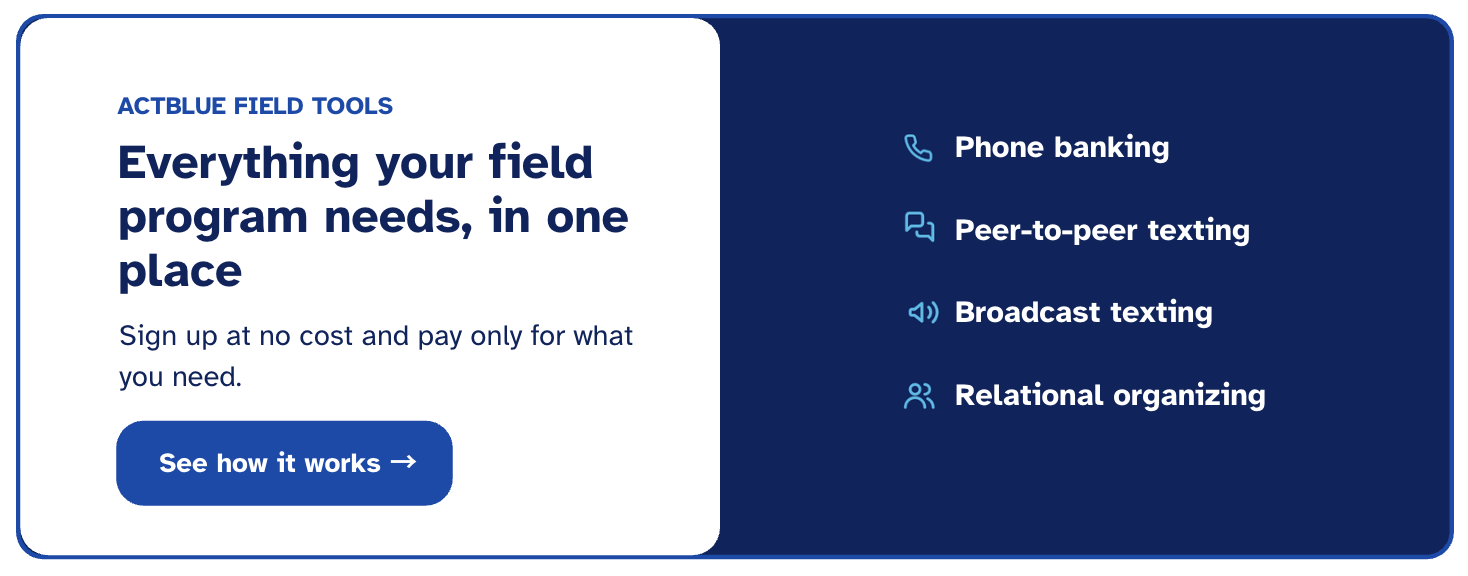
A voter outreach program may include door-to-door canvassing, phone banking, peer-to-peer texting, community events, house parties, email, social media, and relational organizing through volunteers’ personal networks. You don’t need every channel at once. Prioritize the methods that reach the voters most likely to participate in your election and that create room for real conversation.
Track what you learn from every contact. Note which issues come up most often, who supports the campaign, who wants more information, and who might volunteer or make introductions. That data should guide your message and your next round of outreach.
Keep campaign activity strictly separate from official school resources unless local rules clearly permit otherwise. Access to a school building, parent contact list, employee email system, or student information does not make it available to a campaign. Observing that boundary protects students and families and demonstrates the judgment voters expect from a board member.
What should your school board campaign timeline include?
Every campaign moves at its own pace, but working backward from Election Day turns a long list of responsibilities into distinct, manageable phases.
Before filing: Learn how the board operates, attend public meetings, confirm your eligibility, and record every filing and reporting deadline. Begin private conversations with trusted supporters and members of the school community.
Campaign launch: File your paperwork, establish your campaign committee, set up your financial systems, and prepare your website. Announce your candidacy with a clear statement of why you’re running and what you intend to accomplish.
Early campaign: Recruit volunteers, begin fundraising, meet with community members, and introduce yourself to voters. Use what you hear to refine your message and strengthen your outreach plan.
Final 90 days: Increase the pace of canvassing, calling, and texting. Track voter conversations closely and recruit volunteers for the final stretch. Review your budget to ensure the campaign can communicate consistently through Election Day.
Final 30 days: Concentrate your team’s time on the voters most likely to decide the race. Follow up with supporters, respond to outstanding questions, and share accurate information about registration, early voting, mail voting, and polling locations.
Election Day and beyond: Help supporters make and follow through on a plan to vote. Stay in contact with volunteers, handle any issues carefully, and thank everyone who contributed their time, money, and trust. Regardless of the outcome, file every required campaign-finance report and close out the campaign responsibly.
Common mistakes first-time school board candidates should avoid
Missing a deadline: No message or level of enthusiasm can compensate for incomplete paperwork. Put every filing, petition, disclosure, and reporting deadline on a shared calendar, with internal deadlines set well ahead of each one.
Promising what the board cannot deliver: Voters deserve an accurate picture of what a single board member can accomplish. Know which decisions belong to the board, which belong to the superintendent, and which are governed by state or federal law.
Running on a single issue: A particular decision may have prompted your candidacy, but board members are responsible for the full scope of the district’s needs. Show voters you are prepared to engage on budgets, student outcomes, facilities, personnel, and long-term governance.
Confusing visibility with voter contact: Signs, social media, and endorsements build name recognition. They do not replace direct conversations with voters. Make direct outreach the center of your campaign, and use other communications to reinforce it.
Trying to carry the campaign alone: First-time candidates routinely underestimate how quickly administrative work competes with fundraising and voter contact. Delegate early, give volunteers meaningful responsibilities, and build systems that allow the campaign to grow without depending entirely on you.
Your first steps: a school board campaign checklist
- Identify the seat and district you want to represent.
- Attend board meetings and learn what the office controls.
- Confirm your eligibility with the appropriate election authority.
- Request the current candidate guide.
- Record every filing, petition, disclosure, and reporting deadline.
- Review previous election results and calculate your vote goal.
- Talk with people across the school community.
- Define your reason for running and your core priorities.
- Create an initial budget and fundraising goal.
- Recruit a small group of trusted supporters.
- Establish your financial and recordkeeping systems.
- Launch your website and begin reaching voters.
Everything you need to run your campaign
Successful school board campaigns are built through preparation, discipline, and sustained contact with voters. Learn the role thoroughly, listen to the community you hope to serve, and give voters a clear reason to trust you with their schools.
ActBlue’s down-ballot tools are designed to work together so first-time candidates can put a complete campaign infrastructure in place from the start: Raise for fundraising, Website Builder for a professional campaign website, and Field Tools for recruiting volunteers and reaching voters. The result is a campaign that can focus its time where it matters most, on the voters who will decide the race.
This post is provided for general informational purposes only and does not constitute legal advice. Campaign practices, including voter contact, data use, and fundraising, are governed by federal, state, and local law that varies by jurisdiction and changes over time. You are responsible for your campaign’s compliance. Consult your own legal counsel with legal questions.
Built for you. Built to win.
- Fundraising
- Field Tools
- Website Builder