
Figuring out when to launch your campaign website can feel like one more decision in a process that has plenty of them. Launch too early, and you might worry that you don’t have enough policy details to share. Wait too long, and voters, donors, volunteers, and reporters could start searching for your campaign before there’s a reliable place to find it.
Luckily, the first iteration of your website doesn’t need to contain an exhaustive policy platform or a packed events calendar. All it needs to do is establish that you’re running, introduce you to voters, and give supporters a clear way to donate, volunteer, or stay in touch. You can continue adding information as your campaign develops.
Exactly how early you should launch depends on a few things. Here’s how to think about your campaign website timeline based on the type of race you’re running.
The short answer: Launch as soon as your campaign is public
In most races, your website should be ready when you formally announce your candidacy or shortly afterward. The moment your campaign becomes public, people will start searching for your name through social media, local news, or word of mouth.
Your website gives those potential supporters a place to learn more on their own time. It also gives you somewhere consistent to direct people from campaign materials, emails, social posts, event invitations, and conversations at the doors.
Additionally, launching early helps your website begin appearing in search results. It can take time for search engines to discover and understand a new website, so publishing well before Election Day gives your campaign a better chance of appearing when voters search for your name or race.
When to launch a website for a school board campaign
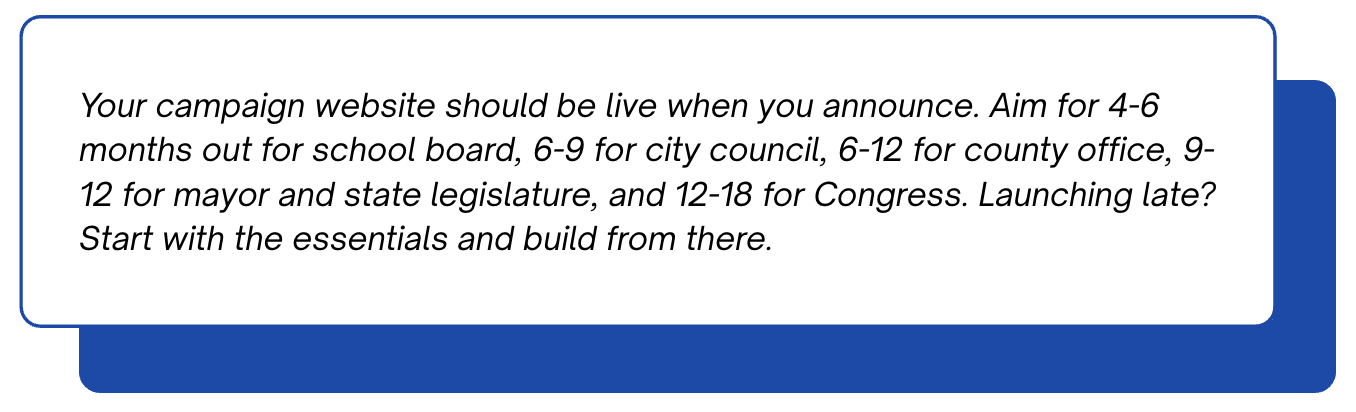
School board elections can have relatively short campaign cycles, especially in smaller districts where candidates may not begin organizing until a few months before Election Day. Still, your website should ideally launch four to six months before the election.
That gives parents, educators, students, and other community members time to learn about your background and priorities. It also gives you a home for information that may not fit neatly into a social media post, such as your experience with the district, your reasons for running, and your positions on issues affecting local schools.
If your race includes a primary, caucus, convention, or endorsement process, work backward from that date rather than the general election. Your website should be live before you begin actively seeking endorsements, donations, or volunteer support.
A school board campaign website can start with:
- Your name, office, and election date
- A short biography
- Your reason for running
- Two or three initial priorities
- A clear way to donate or volunteer
- Information about how voters can contact your campaign
You can add more detailed issue pages, endorsements, event information, and voting resources later. The goal at launch is to give your campaign a credible public presence; don’t worry about needing to answer every possible question on day one.
Recommended launch window: Four to six months before Election Day, or before your public announcement.

When to launch a website for a city council campaign
City council campaigns often require more time to build name recognition across neighborhoods, develop relationships with community groups, and recruit volunteers. Aim to launch your website six to nine months before the election, particularly if you’re a first-time candidate or running in a contested race.
Your timeline may depend on whether council seats are elected by district or citywide. A district race usually involves a smaller electorate, but that doesn’t necessarily mean you should wait longer to launch. Early visibility can be especially valuable in local races where many voters are unfamiliar with the candidates.
Citywide candidates may need additional time to introduce themselves across a larger and more varied community. If you expect a competitive primary, a crowded field, or significant fundraising needs, launching nine to twelve months ahead may make sense.
Before publishing, confirm that your campaign has met any applicable registration and disclaimer requirements. Rules vary by jurisdiction, so check with your local election office before accepting contributions or paying for campaign materials.
Recommended launch window: Six to nine months before Election Day, or earlier for a competitive citywide race.
When to launch a website for a mayoral campaign
Mayoral races generally attract more attention than other municipal contests, which means candidates should plan for a longer campaign runway. A website should ideally be ready nine to twelve months before Election Day and live when the campaign is announced.
Because mayors are responsible for representing an entire city or town, voters will expect more information about your qualifications, priorities, and vision. Your website will also serve several different audiences at once, including residents, donors, volunteers, endorsing organizations, local media, and community leaders.
That doesn’t mean every part of the website needs to be finished immediately. At launch, focus on telling voters who you are, why you’re running, and what kind of leadership you’ll bring to the office. More detailed plans can be published as they’re developed.
A mayoral campaign should also reserve time before launch for basics such as professional photography, brand development, contribution processing, volunteer forms, and required legal language.
Recommended launch window: Nine to twelve months before Election Day.
When to launch a website for a county office campaign
Candidates for county commission, sheriff, district attorney, clerk, treasurer, and other county offices may need to reach voters across several communities. Depending on the size of the county and the visibility of the office, your campaign could resemble either a local municipal race or a larger legislative campaign.
Plan to launch your website six to twelve months before Election Day. Candidates running countywide should generally choose the earlier end of that range, especially in geographically large counties or races with competitive primaries.
Your website should clearly explain what the office does. Many voters encounter county offices only occasionally, so don’t assume that everyone understands the position’s responsibilities or how its decisions affect their daily lives. Connecting the office to recognizable local concerns can make your candidacy easier to understand.
Recommended launch window: Six to twelve months before Election Day.
When to launch a website for a state legislative campaign
State House and State Senate candidates should aim to launch their websites nine to twelve months before the general election. In states with early primaries, party conventions, or demanding ballot-access requirements, candidates may need to launch even sooner.
A state legislative district can include several towns, neighborhoods, or communities with different priorities. The earlier your website is available, the more time you have to introduce yourself across the district and begin building a list of supporters.
Early fundraising can also matter in these races. Even if you begin with a modest goal, a functioning website and contribution page allow interested supporters to act immediately. Those early donors can become volunteers, recurring contributors, event hosts, or trusted advocates for your campaign.
Recommended launch window: Nine to twelve months before Election Day, with your primary or nominating process guiding the final deadline.
When to launch a website for a congressional campaign
Congressional campaigns usually require the longest lead time. Candidates should plan to launch twelve to eighteen months before the general election, depending on the district, primary calendar, fundraising requirements, and expected competitiveness of the race.
A congressional campaign website needs to support a larger operation and reach a much broader electorate. It may also receive immediate attention from reporters, political organizations, potential endorsers, and prospective donors. Having the website ready before the announcement ensures that people who hear about the campaign can learn more and get involved right away.
The launch version still doesn’t need to include a comprehensive position on every federal issue. It should make the candidate’s story, motivation, and central campaign argument clear. Additional policy plans, endorsements, press coverage, and campaign updates can follow.
Recommended launch window: Twelve to eighteen months before Election Day.
Help! What if I’m launching later than recommended?
If you’re already inside these suggested windows, don’t get discouraged! A basic website that launches today is more useful than an elaborate website that stays unfinished for another month.
Start with the information voters need most:
- Who you are
- What office you’re seeking
- Why you’re running
- When the election takes place
- How people can donate, volunteer, or contact you
Once those essentials are live, you can keep building. Add issue pages as your platform develops. Publish endorsements as they come in. Create a voting information page once registration deadlines, polling locations, and voting options are confirmed.
A phased launch is often the most practical approach for a first-time or down-ballot campaign. Your website should grow alongside the campaign instead of becoming a major project that delays everything else.
Work backwards from the first important date
Election Day matters, but it isn’t always the most useful starting point for planning your website launch. Look at the full calendar and identify the first date when voters, donors, or endorsing organizations will need to evaluate your campaign.
That date might be:
- Your public campaign announcement
- The opening of candidate filing
- A party caucus or nominating convention
- An endorsement questionnaire deadline
- Your primary election
- Your first fundraising event
- The beginning of petition or signature collection
Your website should be live before that moment, with enough time to review it on desktop and mobile, test every form and link, and confirm that required disclaimers are present.
Your website doesn’t have to be finished to start working
Your website isn’t a one-and-done kind of deal. Your campaign will gain endorsements, refine its message, announce events, release plans, and respond to new developments throughout the race. The site you publish at the beginning shouldn’t look exactly like the one voters visit during GOTV.
What matters is giving your campaign a strong foundation early. Launch with a clear story and straightforward ways to participate, then improve the site as your campaign gathers momentum.
Build your campaign website with ActBlue Website Builder
ActBlue Website Builder helps down-ballot campaigns launch professional, campaign-ready websites without starting from a blank template. With customizable designs, built-in accessibility, mobile optimization, and a search-friendly foundation, candidates can establish their online presence quickly and continue adding to it throughout the race. No technical experience, no setup fee.
Built for you. Built to win.
- Fundraising
- Field Tools
- Website Builder