A single county can include a busy downtown, growing suburbs, small towns, farmland, and miles of rural roads. The people who live in those places may have very different daily lives, but they rely on the same county government for public health, emergency services, elections, courts, roads, and more.
That makes county commissioner races different from most local contests. You’ll need to earn support from communities that don’t always share priorities, in places you may not know well yet, often across long distances.
ActBlue has supported Democratic candidates for more than two decades, and county races consistently reward the same things: a clear understanding of what the county controls, a coalition that reaches beyond your home base, and a field plan built for the county’s geography. This guide walks you through each of them.
What does a county commissioner do?
County government is one of the most consequential and least understood levels of government. Depending on the state, its governing body may be called a commission, board of supervisors, county council, or even a commissioners court presided over by a county judge. Whatever the title, commissioners typically approve the budget, set policy, oversee county departments, and make decisions about county property and services.
What a county is responsible for depends heavily on state law. Common responsibilities include:
- Public health and human services
- Roads, bridges, and transportation
- Courts, jails, and public safety
- Emergency management
- Elections and voter registration
- Property assessment and tax administration
- Land use and development in unincorporated areas
- Parks, libraries, and public facilities
- Environmental protection and waste management
- Housing and economic development
Commissioners also share power with other independently elected officials, such as the sheriff, clerk, treasurer, assessor, prosecutor, or coroner. The commission often funds these offices without directing their daily work. A commissioner can shape priorities through the budget, policy, and oversight, but doesn’t control every county service directly. Understanding that distinction is essential to building a credible platform.
Start by learning how your county is structured. Read its charter or the state laws that govern it, and review the organizational chart, current budget, meeting agendas, and strategic plans. Watch commission meetings and budget hearings. The National Association of Counties is a useful resource on what counties do nationally, but your county’s own documents will show you exactly where its authority begins and ends.
Confirm your eligibility
Qualifications vary by state and county. Candidates generally must be registered voters and county residents, and district seats may require you to live in that district. Some states also set minimum age or residency-duration requirements, and local rules may address conflicts of interest or county employment.
Next, find out how your seat is elected. There are three common models:
- District elections: Only voters in your district choose their commissioner.
- At-large elections: Voters across the county elect commissioners who can live anywhere in the county.
- Residency districts: You must live in a specific district, but voters countywide cast ballots for the seat.
Some boards combine these systems. The model matters because it defines who your voters are, how far your campaign needs to travel, and how much it will cost to reach them.
Races may also be partisan or nonpartisan. A partisan race may require winning a party primary before the general election. A nonpartisan race may use a preliminary election or runoff to narrow the field. Ask the office administering your election to walk you through every stage of your race and what it takes to advance.
Your county elections office, clerk, or state election authority can provide the current candidate guide and official district maps. Confirm every requirement with that office directly rather than relying on a neighboring county’s rules or a previous cycle.
Qualify for the ballot
Your candidate guide will list the required documents, the filing period, and where to submit. Depending on your jurisdiction, you may need:
- A declaration or statement of candidacy
- A filing fee, or a petition in lieu of a fee
- Nomination petitions with voter signatures
- Party qualification paperwork
- An appointed treasurer or campaign committee
- Campaign-finance registration
- Financial or economic-interest disclosures
- A loyalty oath, ethics form, or other state-required document
If you’re collecting signatures, check district boundaries carefully. A voter can live in the county but outside your district, which may disqualify their signature. Petition rules may also govern who can circulate, how signers list their addresses, whether pages must be notarized, and how they’re submitted.
Where the rules permit, collect well above the minimum. Build time into your plan to review every sheet, correct problems, and file before the final day. The discipline it takes to manage the ballot process is the same discipline you’ll need for finance reports, voter contact, and Election Day.
Calculate your vote goal
The number of votes you need depends on how your county decides elections:
- Plurality races: The candidate with the most votes wins, even without a majority.
- Majority requirements: A candidate must clear 50% to win outright. Otherwise, the top finishers typically go to a runoff.
- Multi-seat races: When several seats are filled at once, the top vote-getters win.
To estimate your vote goal, review turnout and results from several recent elections for the same seat, and set your target somewhat above what past winners received. Then break it down by precinct and community. In a county race, that geographic breakdown is especially important. It tells you where your votes are, how far apart they are, and how to allocate a limited amount of candidate and volunteer time.
Define your campaign priorities
Residents interact with county government at important moments: seeking public health services, appearing in court, registering property, voting, driving on a county road, or applying for assistance. Many don’t know which level of government is responsible for the service they’re using.
Your priorities should help voters make that connection. Focus on decisions county commissioners actually make, not issues borrowed from federal or statewide races. Study the budget to see where county revenue comes from, which services take the largest share, and which costs are mandated by the state. Review capital plans, audit findings, department reports, and major contracts.
Then listen across the county. Meet with municipal officials, tribal leaders where applicable, farmers, labor organizations, health care providers, service agencies, small businesses, neighborhood groups, and residents of unincorporated areas. Ask how county decisions affect them and where coordination between governments is breaking down.
Choose a few priorities that matter across different communities and fall within county authority. For each one, be ready to explain:
- What residents are experiencing now
- What the county is responsible for
- What you would work to change
- How it would be funded or implemented
- How residents would stay involved
A rural township and an urban neighborhood may describe their needs differently while sharing the same underlying concerns: reliable infrastructure, accessible services, responsible growth, and accountable government. Strong county candidates understand both the differences and the common ground.
Build a countywide coalition
Commissioners have to work across municipal lines and political constituencies. Your campaign is the first place to show voters you can do that.
Build a listening plan that covers every major part of the county. Attend city and town meetings, agricultural events, neighborhood gatherings, union meetings, civic associations, cultural events, and local party functions. Track where you’ve been. Without a deliberate plan, campaigns tend to return to the same familiar places and repeat the geographic blind spots that frustrate residents about county government in the first place.
Learn how the commission works with school districts, municipalities, regional authorities, state agencies, and community organizations. The people who deliver services and administer programs can show you where county leadership could make collaboration easier and where it currently falls short. Those relationships also become the backbone of your coalition.
Build a regional campaign team
In a county race, geography makes local leadership essential. A central team can set strategy, manage finances, and run communications, but it won’t have deep relationships in every community you need to reach.
Recruit regional or precinct leaders who know their part of the county. They can introduce you to residents, flag important local events, recruit nearby volunteers, and keep the campaign from treating every community the same. In large or rural counties, they can also help plan realistic canvass routes and identify where phone calls, texting, mail, or community events will outperform door-knocking.
Your core team should have clear owners for:
- Strategy and scheduling
- Fundraising
- Financial reporting and compliance
- Field organizing and volunteer management
- Communications and local media
- Endorsements and coalition outreach
- Events and candidate forums
Make sure information moves in both directions. Regional volunteers need to know the campaign’s message, and the central team needs to hear what volunteers are learning. That feedback shows you when an issue is resonating countywide and when your approach needs to change from one community to the next.
Build a fundraising plan
Build your budget first. Estimate the cost of your campaign website, printed materials, events, digital outreach, texting, direct mail, and other voter contact, and account for the added travel and logistics a large county requires. Then break the total into goals tied to campaign phases. For example, your first-month goal might cover your website and first round of literature, with a larger goal later to fund expanded voter outreach.
Next, build a list of prospective donors, starting with people who know you and your record in the community. Ask personally, beginning with those most likely to say yes. Explain why you’re running, what you hope to accomplish, and what their contribution will pay for, and ask for a specific amount: “Would you contribute $50 to help us print literature for our campaign launch?”
Your first donors can help you reach the next ones. Ask them to share your fundraising page, introduce you to other potential supporters, or host a small gathering. In a county race, house parties hosted in different parts of the county do double duty: they raise money and introduce you to communities outside your home base. As the campaign grows, add:
- A campaign launch event
- Personal fundraising calls
- Email and text appeals
- Pushes tied to filing deadlines or campaign milestones
- Asks tied to a specific need, like funding a countywide mailing
Launch your campaign website
Your campaign website will introduce you to voters in communities where you may not be well known yet. It should explain what a county commissioner does, why you’re running, and how your priorities connect to residents’ lives.
Include:
- Your name, office, district, and election date
- A map or clear description of the area you’d represent
- Your biography and connection to the county
- A brief explanation of the commissioner’s role
- Your county-specific priorities
- Ways to donate, volunteer, endorse, or contact the campaign
- Voting information as the election approaches
- Required campaign disclaimers
Write in plain language. Voters shouldn’t need to decode a department acronym or understand the division between city and county responsibilities to follow your positions. Connect county decisions to services and experiences they already know.

Build a countywide field program
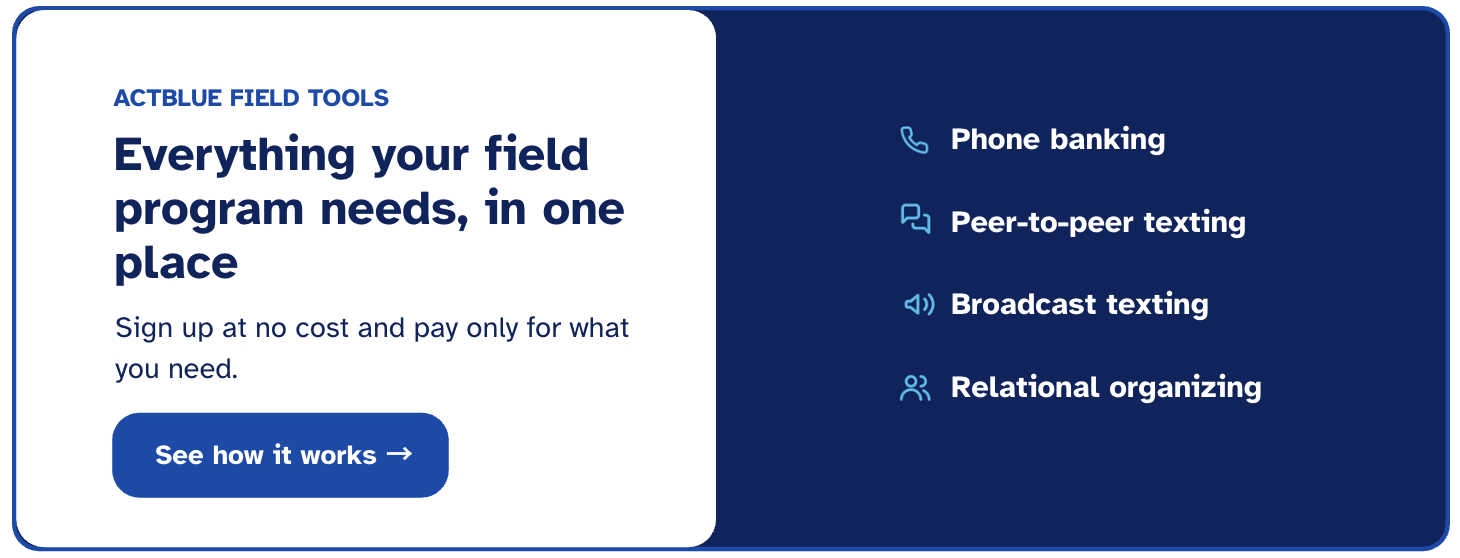
A county field plan has to account for distance, population density, and local voting patterns. Door-to-door canvassing is most efficient in dense neighborhoods and suburban precincts. In rural areas where homes are far apart, phone banking, peer-to-peer and broadcast texting, relational organizing, community events, and direct mail carry more of the load. Most county campaigns need all of these, deployed where each works best.
Don’t underestimate local media. Newspapers, radio stations, and community publications often carry real influence in county races, especially in rural areas. Build relationships with reporters across the county, and track candidate questionnaires, editorial board meetings, debates, and forums so you don’t miss a chance to reach voters.
Keep all your voter contact data in one place and use it to make decisions. Track where you’ve canvassed, who supports you, where volunteers are active, and which areas need more attention.
What should your county commissioner campaign timeline include?
Before filing Learn how the commission is structured and which responsibilities belong to the county. Study the budget, district map, election rules, and past results. Start meeting with people across the county and identify potential members of your core team.
Filing and launch Complete your candidate and campaign-finance paperwork and collect signatures if required. Launch your website and fundraising program, and announce with a message grounded in county needs.
Building countywide support Recruit regional leaders, expand fundraising beyond your personal network, and show up at events in every part of the county. Meet with local officials, service providers, and community organizations. Start voter outreach early enough to learn from it.
Final 90 days Increase canvassing, phone banking, and texting. Measure progress against your vote goal and close geographic gaps. Prepare for forums, interviews, endorsement processes, and major finance deadlines.
Final 30 days Focus resources on the precincts and voters most important to your path to victory. Follow up with identified supporters, share voting information, and prepare volunteers across the county for early voting and Election Day turnout.
Election Day and after Help supporters follow through on their plans to vote and keep accurate election information easy to find. Stay in contact with regional volunteers throughout the day. After the election, thank your supporters and complete every required financial report and closeout step.
Common mistakes first-time county commissioner candidates should avoid
Assuming county government works like city government Cities and counties often provide different services, even in the same place. Learn which responsibilities belong to each before you define your platform.
Overlooking independently elected offices Commissioners often fund departments they don’t manage. Understand how authority is divided among the commission, county administrator, sheriff, clerk, prosecutor, and other officials.
Building a platform without reading the budget County budgets often include state-mandated costs and restricted funds that commissioners have little power to redirect. Knowing the numbers makes your proposals credible.
Campaigning only where you’re comfortable Your district or county may include communities with very different economies, infrastructure, and needs. Make time for all of them, including places with fewer voters or less political influence, and tailor your examples and outreach to local realities.
Underestimating travel and logistics A large county demands more planning, coordination, and candidate time. Group events and canvasses geographically instead of losing hours driving back and forth.
Building regional leadership too late You can’t personally maintain every relationship across a large county. Recruit trusted local leaders early and give them what they need to organize their own communities.
Your first steps: a county commissioner campaign checklist
County campaigns involve more ground, more communities, and more moving parts than most local races. This checklist brings together the key steps from this guide, from learning what your county controls to building a regional team and launching your campaign.
- Learn what county commissioners control in your state.
- Determine whether your seat is elected by district, at large, or countywide from a residency district.
- Review the county charter, budget, organizational chart, and strategic plans.
- Confirm your eligibility and request the current candidate guide.
- Record every filing, petition, disclosure, and reporting deadline.
- Study past results by district and precinct.
- Set a vote goal and map your geographic path to victory.
- Meet with residents, local officials, and organizations across the county.
- Choose priorities grounded in county authority.
- Build a campaign budget around the cost of reaching voters.
- Recruit a core team and regional volunteer leaders.
- Launch your website, fundraising program, and voter outreach.
Turn your decision to run into a campaign
Winning a county commissioner race means seeing the whole county: the communities at its center and its edges, the services residents depend on, and the ways local governments can work better together. Candidates who listen across geographic and political lines build campaigns, and coalitions, that last beyond Election Day.
ActBlue’s down-ballot tools give first-time candidates the infrastructure to run that kind of campaign from day one: Raise for fundraising, Website Builder for a professional campaign website, and Field Tools for recruiting volunteers and reaching voters across the county. They’re built to work together, so your campaign can spend less time managing separate systems and more time meeting voters. See ActBlue’s campaign-in-a-box in action and watch a demo.
This post is provided for general informational purposes only and does not constitute legal advice. Campaign practices, including voter contact, data use, and fundraising, are governed by federal, state, and local law that varies by jurisdiction and changes over time. You are responsible for your campaign’s compliance. Consult your own legal counsel with legal questions.
Built for you. Built to win.
- Fundraising
- Field Tools
- Website Builder